

How Does Ferro Alloys Production Work? Process, Raw Materials, Technologies and Quality Standards Explained
How Does Ferro Alloys Production Work? Process, Raw Materials, Technologies and Quality Standards Explained
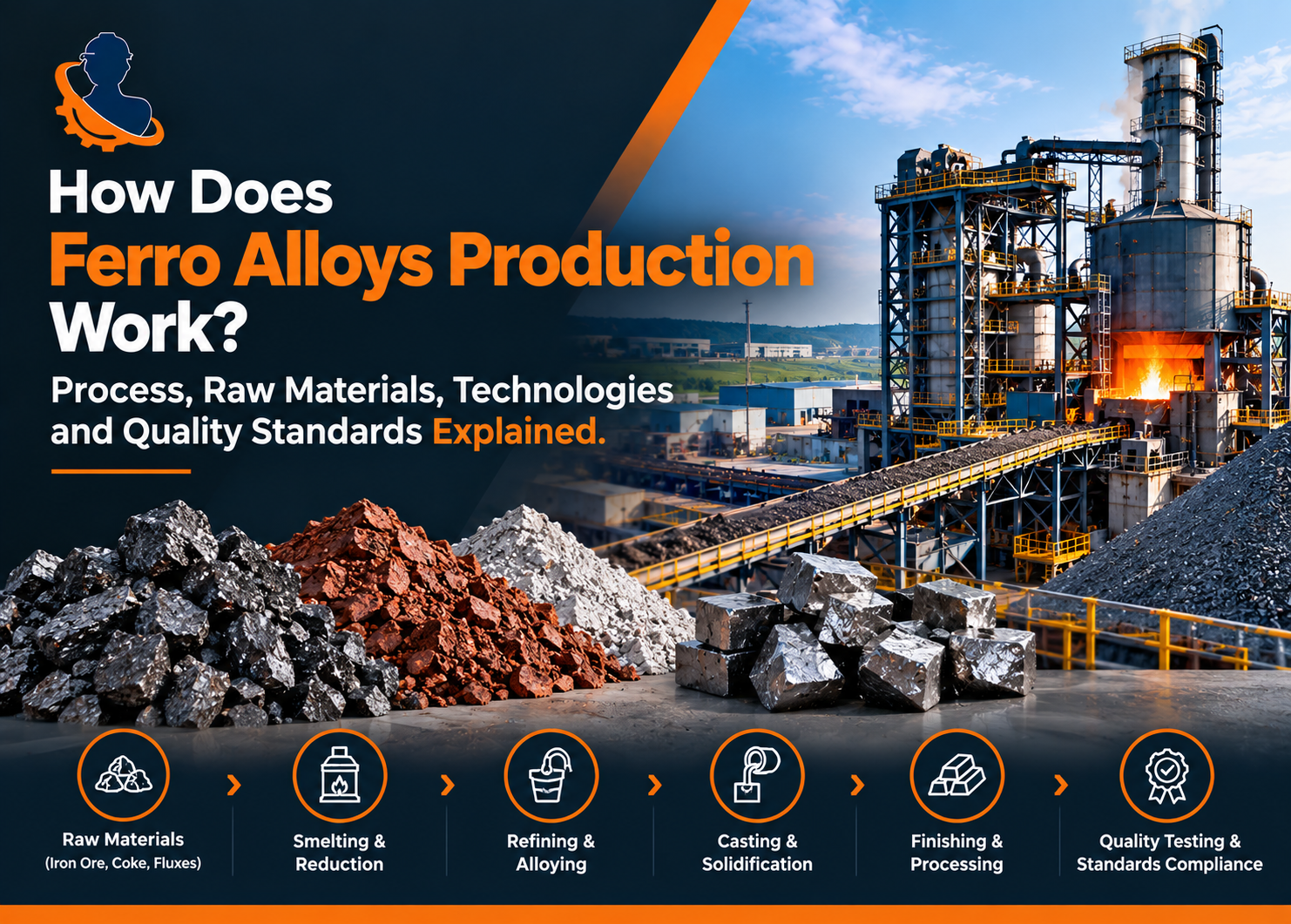
Ferro alloys are essential inputs in modern steelmaking. They introduce elements that improve strength, hardness, corrosion resistance, heat tolerance and other valuable properties. Their manufacture requires carefully selected raw materials, controlled furnace conditions, dependable technology and rigorous testing.
For buyers and steel producers, knowing how ferro alloys move from mineral inputs to finished products makes supplier evaluation easier. It also clarifies why chemical consistency, production capacity, process control and dependable delivery matter when selecting a manufacturer such as Sarojini Group.
What Are Ferro Alloys?
Ferro alloys are metallic combinations in which iron forms an alloy with one or more elements, such as manganese, chromium, silicon, molybdenum, vanadium or titanium. Manufacturers primarily produce these materials for the iron and steel sector.
Steel plants add specific ferro alloys during melting, refining or casting to achieve the required composition. Each alloy performs a particular metallurgical role. Some remove unwanted oxygen or sulphur, while others improve hardness, toughness, wear resistance or corrosion protection.
Common varieties include:
- Ferro manganese
- Silico manganese
- Ferro silicon
- Ferro chrome
- Ferro molybdenum
- Ferro vanadium
- Ferro titanium
- Ferro niobium
- Ferro boron
The required alloy depends on the steel grade and its intended application. Construction steel, stainless steel, tool steel, railway components, automotive parts and high-temperature equipment all demand different chemical properties.
Why Ferro Alloys Matter in Steelmaking
Iron alone cannot satisfy the performance requirements of most industrial applications. It may lack the strength, durability or resistance needed for demanding operating conditions. Alloying elements allow steelmakers to modify those properties with greater precision.
Manganese improves strength, hardness and resistance to impact. It also helps remove sulphur and oxygen from molten steel. Silicon acts as an effective deoxidiser and can improve strength and magnetic performance. Chromium supports hardness, wear resistance and corrosion protection, particularly in stainless steel.
Other elements serve more specialised purposes. Vanadium can refine the grain structure and increase strength, while molybdenum improves performance at elevated temperatures. Titanium may control grain size and stabilise certain steel grades.
The quality of these alloy additions directly affects the behaviour of finished steel. Irregular composition, excessive impurities or inconsistent sizing can disrupt melting, increase slag formation and produce variable results.
Essential Raw Materials Used in Manufacturing
Successful manufacturing begins with the correct selection and preparation of raw materials. Ore quality, reductant properties, flux composition and particle size influence furnace efficiency, alloy recovery and final chemistry.
Mineral Ores
The principal ore depends on the alloy being manufactured. Manganese ore supports ferro manganese and silico manganese manufacturing, while chromite ore supplies chromium for ferro chrome. Quartz or silica-rich materials provide silicon for ferro silicon.
Manufacturers assess ores for:
- Desired metal content
- Moisture level
- Phosphorus and sulphur
- Alumina, silica and other gangue materials
- Particle-size distribution
- Thermal behaviour
- Reducibility
- Consistency between shipments
Higher metal content can improve productivity, but the complete chemical profile matters. An ore with undesirable impurities may require additional processing or blending, even when its main metal concentration appears suitable.
Reducing Agents
Metal oxides present in ores must lose oxygen before they can form an alloy. Carbon-based reductants provide the chemical reaction needed for this conversion.
Coke, coal, charcoal and specialised carbon materials may serve as reductants. Their fixed-carbon level, ash content, volatile matter, strength, reactivity and electrical resistance affect furnace operation.
An unsuitable reductant can raise energy consumption, create unstable furnace conditions or introduce unwanted impurities. Producers therefore test and blend carbon materials according to the furnace design and alloy specification.
Fluxes
Fluxes help control slag chemistry, melting behaviour and impurity separation. Limestone, dolomite, quartzite and other mineral additions may be used, depending on the process.
The correct flux balance supports fluid slag, effective metal recovery and smooth tapping. Excessive or insufficient flux can reduce yield, increase power demand and complicate slag handling.
Iron-Bearing Materials
Iron may enter the process through iron ore, steel scrap, mill scale or other approved sources. The selected material must meet chemical and cleanliness requirements because unwanted elements can pass into the finished alloy.
Raw Material Preparation and Proportioning
Plants inspect incoming materials before releasing them for production. Sampling and laboratory analysis verify chemical composition, moisture and physical condition. Materials that fail internal acceptance limits may be rejected, segregated or blended with suitable stock.
Crushing and screening bring ores, reductants and fluxes within the required size range. Very large pieces may react slowly, while excessive fines can restrict gas flow and disturb the burden inside the furnace.
Some facilities use drying, washing, beneficiation, sintering, briquetting or pelletising to improve feed quality. These operations can reduce moisture, remove unwanted minerals, recover fines or create stronger furnace feed.
After preparation, the plant calculates a charge mix based on the target alloy composition. Modern systems use laboratory results, historical furnace data and material-balance calculations to determine suitable proportions. Accurate weighing prevents avoidable variations and supports stable production.
The Smelting Process
Smelting forms the central stage of ferro alloys production. Most bulk alloys are manufactured in submerged arc furnaces, although other furnace types and metallurgical routes may suit specialised products.
Prepared raw materials enter the furnace in controlled proportions. Large electrodes extend into the charge and supply electrical energy. Resistance within the burden generates intense heat, causing the materials to react, soften and melt.
At high temperatures, carbon removes oxygen from metal oxides. The reduced metals combine with iron and collect as molten alloy. Non-metallic materials form a separate molten slag layer.
The exact reactions depend on the alloy. Manganese and chromium oxides require carefully maintained reducing conditions, while silicon manufacturing demands particularly high temperatures. Operators control power input, electrode depth, burden movement and raw material feeding to sustain the correct reaction zone.
How a Submerged Arc Furnace Operates
A submerged arc furnace usually has a circular shell lined with refractory materials. Three electrodes enter the burden from above. Because the electrode tips remain buried in the charge, heat develops within the raw material bed rather than through an open electric arc.
This arrangement provides several advantages:
- High thermal efficiency
- Continuous or semi-continuous operation
- Strong production capacity
- Controlled reduction reactions
- Suitability for several bulk alloys
- Reduced direct heat radiation
Raw materials descend as reactions occur in the lower furnace. Fresh charge enters from the top, while molten metal and slag collect near the hearth.
Operators monitor electrode movement, electrical load, furnace pressure, gas behaviour and charge distribution. A poorly distributed burden may create cold zones, gas channels or irregular reactions. Skilled control helps maintain stable smelting and consistent output.
Tapping, Slag Separation and Casting
Once enough molten material accumulates, operators open a tap hole to release metal and slag. The stream flows into ladles, runners or separation equipment designed for the particular alloy and plant arrangement.
Because molten metal and slag have different densities, they can be separated. Effective separation improves alloy recovery and prevents excessive slag inclusion in the final product.
The alloy then moves to casting beds, moulds or granulation systems. Traditional casting produces solid slabs or cakes that cool before crushing. Granulation forms smaller particles by safely breaking the molten stream under controlled conditions.
Cooling speed can influence structure, brittleness and crushing behaviour. Plants therefore manage casting and cooling according to the physical characteristics required by customers.
Crushing, Screening and Product Sizing
After solidification, large alloy pieces pass through crushing and screening systems. Customers generally require defined size ranges because particle size affects material handling, furnace charging, dissolution speed and recovery during steelmaking.
Common commercial forms include:
- Lumps
- Chips
- Granules
- Fines
- Briquettes
- Powder for specialised applications
Magnets and mechanical separation systems may remove unwanted material. Screens classify the alloy into customer-approved fractions, while oversize pieces return for further crushing.
Careful handling matters because excessive drops can create unnecessary fines. Dust-control systems, covered conveyors and enclosed transfer points help protect product quality and improve workplace conditions.
Refining and Specialised Production Routes
Basic furnace smelting may not achieve the low carbon, low phosphorus or tightly controlled chemistry required for certain applications. Producers can use additional refining stages to adjust the alloy.
Low-carbon ferro chrome, for example, may involve silicon-based reduction rather than direct carbon reduction. Specialised alloys may also use aluminothermic reactions, in which aluminium acts as the reducing agent. This route can produce metals with lower carbon levels but requires precise reaction control.
Vacuum treatment, ladle refining, controlled oxidation and selective slag practices may further reduce impurities. The chosen route depends on the target grade, production volume, cost structure and customer specification.
Technologies Supporting Process Control
Modern plants combine heavy industrial equipment with digital monitoring. Sensors and control platforms collect operating information that helps teams maintain stable conditions.
Important technologies include:
- Automated raw material weighing
- Computer-controlled furnace loading
- Electrode regulation systems
- Power and energy monitoring
- Temperature measurement
- Process-gas analysis
- Infrared inspection
- Laboratory information systems
- Production tracking software
- Predictive maintenance tools
Real-time data helps operators recognise unusual power consumption, unstable electrode behaviour or changes in furnace resistance. Early action can prevent larger disturbances and reduce production losses.
Automation does not eliminate the need for metallurgical expertise. Furnace behaviour involves interactions between chemistry, heat, electricity and burden movement. Experienced teams interpret the data and make suitable operational adjustments.
Quality Testing from Input to Finished Alloy
Quality assurance begins before smelting and continues through dispatch. Testing only the final product would allow raw material or process problems to remain unnoticed for too long.
Incoming ores, reductants and fluxes undergo sampling and analysis. During production, teams collect metal and slag samples at defined stages. Laboratories then measure the main alloying element and restricted impurities.
Testing may cover:
- Manganese, chromium or silicon content
- Carbon concentration
- Phosphorus and sulphur
- Aluminium, titanium or other trace elements
- Moisture
- Particle size
- Bulk density
- Slag contamination
- Physical appearance
Laboratories commonly use optical emission spectrometry, X-ray fluorescence, combustion analysis, wet chemical methods and particle-size testing. The chosen technique depends on the element, required accuracy and product specification.
Representative sampling remains crucial. Even advanced instruments cannot correct a poorly collected sample. Plants therefore establish sampling locations, frequencies, preparation methods and retention procedures.
Quality Standards and Customer Specifications
Quality requirements vary according to the ferro alloy grade and its final application. A stainless steel producer may apply different limits from a foundry or structural steel plant. Contracts normally define the main element range, maximum impurity levels, size distribution, packaging and test documentation.
A formal quality management system helps a producer control purchasing, manufacturing, laboratory operations, non-conforming material, traceability and corrective action. ISO 9001 commonly supports quality management, while environmental and occupational systems may align with ISO 14001 and ISO 45001.
Laboratories may follow recognised test methods and calibration practices. Depending on the market, specifications can refer to Indian Standards, ASTM requirements, international standards or customer-developed limits.
A reliable certificate of analysis should identify the product, heat or batch reference, chemical results and authorised inspection status. Traceability allows both producer and customer to connect delivered material with its manufacturing and testing records.
Environmental and Safety Controls
Furnace operations generate heat, dust, gases, slag and noise. Responsible manufacturing requires engineered systems and disciplined procedures to control these risks.
Bag filters, extraction hoods and enclosed material-transfer systems capture particulate matter. Gas-cleaning systems treat furnace emissions before discharge or reuse. Some plants recover furnace gas or thermal energy where process conditions and infrastructure permit.
Slag may contain recoverable metal. Crushing and separation can return this metal to production and reduce waste. Suitable processed slag may also serve approved secondary applications when it meets technical and environmental requirements.
Safety measures include heat-resistant protective equipment, furnace-area access controls, moisture prevention, equipment isolation, emergency planning and regular inspection. Water or wet material near molten metal can create a serious hazard, making raw material storage and handling particularly important.
Energy Efficiency and Production Reliability
Electricity represents a major manufacturing cost. Stable furnace operation, suitable raw materials and effective maintenance can reduce energy use per tonne.
Plants improve efficiency through consistent burden sizing, balanced charge recipes, electrode control, refractory care and reduced furnace interruptions. Monitoring specific energy consumption helps teams compare performance across heats, shifts and product grades.
Reliability also depends on spare-parts planning, preventive maintenance and secure raw material sourcing. A producer may possess sufficient installed capacity yet still face delivery problems if equipment availability or material planning remains weak.
Sarojini Group focuses on the connection between quality, capacity and supply discipline. Buyers benefit when production planning, testing, packaging and logistics operate as one coordinated system.
Selecting a Dependable Ferro Alloy Producer
Industrial buyers should evaluate more than the quoted price. A sound assessment considers whether a manufacturer can repeatedly supply the required chemistry, size, volume and documentation.
Buyers should examine:
- Available grades and production capacity
- Raw material control procedures
- Furnace and processing technology
- Laboratory testing capabilities
- Batch traceability
- Quality management practices
- Packaging options
- Delivery planning
- Technical communication
- Handling of non-conforming material
Consistent quality can reduce slag volume, improve alloy recovery and support stable steel chemistry. Reliable sizing can also improve handling and dissolution. These operational gains may provide more value than a small difference in purchase price.
Conclusion
Ferro alloy manufacturing combines mineral preparation, high-temperature reduction, electrical furnace control, casting, sizing and disciplined testing. Every stage influences chemistry, recovery, energy use and delivery performance.
For steelmakers and industrial buyers, dependable supply starts with a producer that controls raw materials, furnace operations, laboratory analysis and logistics. Sarojini Group serves industry requirements with a structured focus on product quality, manufacturing capability and reliable supply coordination.
FAQs
Which furnace is commonly used for ferro alloys production?
Manufacturers commonly use submerged arc furnaces for bulk grades such as ferro manganese, silico manganese, ferro silicon and ferro chrome. Buried electrodes generate heat inside the burden, allowing metal oxides to react with carbon-based reductants and form molten alloy under controlled operating conditions.
How is quality maintained during ferro alloys production?
Plants maintain quality by inspecting raw materials, controlling charge proportions, monitoring furnace parameters and testing samples during and after smelting. Laboratories verify alloying elements, carbon, phosphorus, sulphur, particle size and other specified properties. Batch identification and certificates of analysis provide traceability through dispatch.
What factors affect the cost of ferro alloys production?
Major cost factors include ore grade, reductant quality, electricity rates, electrode consumption, labour, furnace efficiency, alloy recovery, environmental controls, maintenance and logistics. Product specifications also influence cost because low-carbon or low-impurity grades may require additional refining, specialised materials and tighter process control.
NEWSLETTER
Sign up your mailing list to get lastest Updates.